Kultura jako „gęba” i kultura jako dziedzictwo. Gombrowicz i Miłosz wobec wyzwań nowoczesności. Zajęcia dla maturzystów (UO, 13.04.26). Podziękowania dla Pani dr Joanny Zagożdżon-Łyszczarz za zorganizowanie wydarznia.

Kultura jako „gęba” i kultura jako dziedzictwo. Gombrowicz i Miłosz wobec wyzwań nowoczesności. Zajęcia dla maturzystów (UO, 13.04.26). Podziękowania dla Pani dr Joanny Zagożdżon-Łyszczarz za zorganizowanie wydarznia.
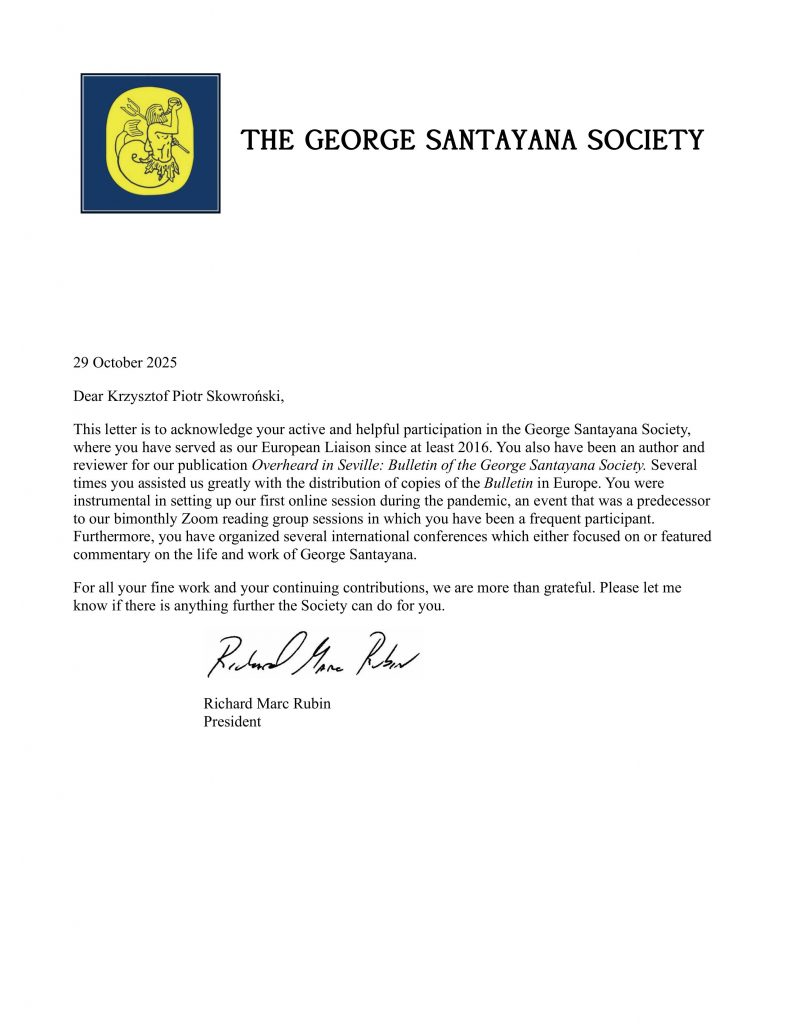
Oxford Handbook of Sangayana to be published soon by Oxford University Press. Chris Skowroński’s chapter: “Populism and Democracy” discusses Santayana’s political thought in the context of populism and democracy.

From Chris Skowrońsk’s “Populism and Democracy” Abstract:
George Santayana’s political thought deserves attention for a variety of reasons. In his widely commented on in books such as The Life of Reason (1905-6), Egotism in German Philosophy (1915), Character and Opinion in the United States (1920), Dominations and Powers (1951), and in other texts. He proposed a definite vision of the political realm that is refreshing and one that provokes reflection on the readers’ part. He discusses the condition of the West in accordance with classic lay humanism, in its naturalistic and non-anthropocentric version, in which the lot of the individual agent should be seen as a primary “seat of observation and judgment.” At the same time, he warns us against illiberal tendencies within liberal democracy itself, “industrial” liberalism in the first instance. He appreciates cultural pluralism but warns us against various forms of populism that could refer to some utopian idea of the ‘people’ as carriers of ‘pure’ values in a given political body, be it a state or a collection of states. He criticizes democracy when it seems to lose its roots in the tradition and historical heritage of the West, and “those who cannot remember the past are condemned to repeat it” is widely quoted in a variety of political contexts. One can even see a plaque with this quote in the former German Nazi concentration camp of Auschwitz.


Recent Comments